
From bacterial food sources to cell gene activity: Four new, wild projects
Four bold and innovative ideas from the Department of Biology at the University of Copenhagen have received support through the Villum Foundation’s programme for unconventional research projects: Villum Experiment.
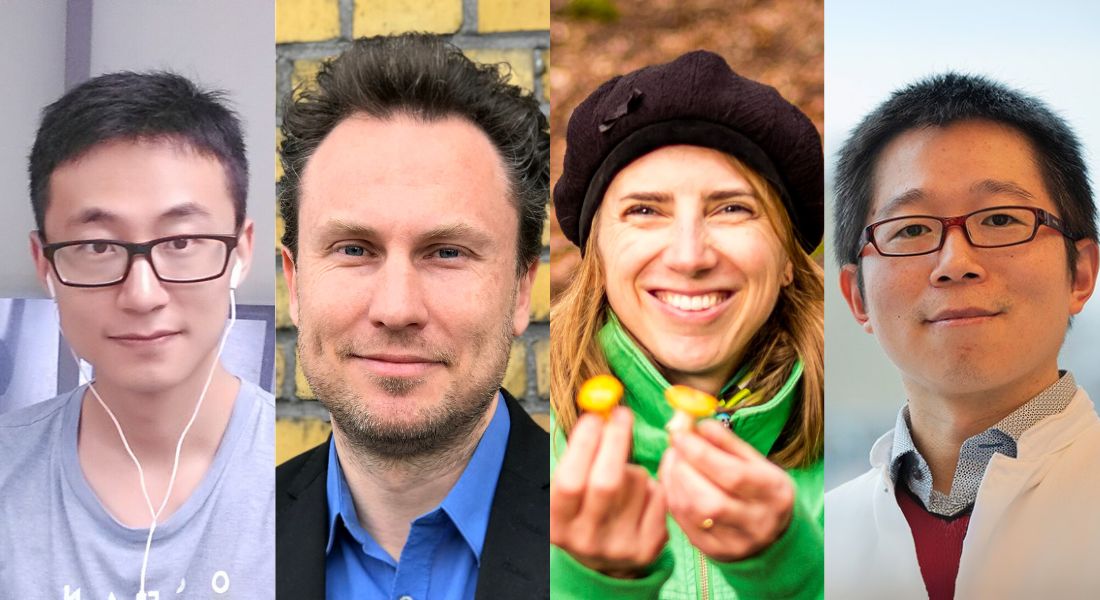
Research projects awarded with a VILLUM Experiment grant are united by their courage to think differently and take risks. The projects were selected through an anonymous peer-review process, where the originality and potential of the idea outweigh the researcher’s CV. This creates space for the unexpected and the untested – which is precisely the essence of Villum Experiment.
- Villum Experiment is about giving room to ideas that don’t necessarily fit into conventional frameworks. We believe that major breakthroughs often hide in the quirky and the wild, says Thomas Bjørnholm, Director of Research at the Villum Foundation, and continues:
- By removing names and credentials from the evaluation, we open up the field to curiosity and courage.
In total, the VILLUM Foundation has awarded funding for 52 projects. Below, you can read about the four projects from the Department of Biology.
The symbiotic trinity – the next step in evolution?
Researcher: Kathrin Rousk, Associate Professor
Grant amount: DKK 2.4 million
Abstract:
Endosymbiosis, the process where one organism engulfs another, has played a key role in the evolution of life on Earth. One of the most significant examples is the origin of plants: a free-living cyanobacterium was engulfed by a host cell, eventually evolving into the chloroplast, the photosynthesizing organelle in plant cells. Last year, a groundbreaking discovery identified another potential endosymbiosis event: a free-living, nitrogen (N)-fixing cyanobacterium was engulfed by a marine alga, forming the marine nitroplast. This new organelle supplies the host with newly fixed N, a key nutrient for all life. I propose here that we are at the dawn of a terrestrial nitroplost in moss-cyanobacteria symbioses, which can serve as a unique model system to unravel the evolution of a N-fixing organelle. Just as mitochondria and chloroplasts originated from ancient endosymbiotic events, the discovery of a terrestrial nitroplast would complete the “symbiotic trinity”, marking the third organelle acquired by plants.
Methods for relating spatial patterns of microenvironmental pH and oxygen levels with gene expression of single cells
Researcher: Albin Sandelin, Professor
Grant amount: DKK 2.5 million
Abstract:
Local pH and oxygen (O₂) levels are crucial for physiological homeostasis in organs. While the effects of O₂ and, to some extent, pH have been well studied in isolated cell models, their spatial and temporal dynamics and their impact on gene expression in individual cells within organs remain largely unknown. Methods within spatial transcriptomics can measure gene expression in cells in tissues, but there is a lack of methods for simultaneously mapping the effect of pH and O₂ microenvironments on gene expression in individual cells. This project will develop methods for measuring pH and O₂ levels in tissues and integrate these measurements with spatially resolved single-cell gene expression. By applying these methods to liver tissue, we will create models of how local O₂ and pH environments shape cellular gene expression and function. This represents an important step towards a quantitative molecular physiology of organ microenvironments.
War or Peace: Is There an Ecological Switch in the Microbial World?
Researcher: Nan Yang, Postdoc
Grant amount: DKK 2.3 million
Abstract:
The microbial world is shaped by various interactions ranging from cooperation (peace) to competition (war). Uncovering the ecological principles that drive these interactions has been a long-standing challenge in microbiology. Conventional wisdom holds that these interactions are genetically determined. But are there ‘ecological switch(es)’ that can shift microbial social behaviour between war and peace? WoP will explore ecological factors that regulate microbial activity and that may ultimately enable targeted control of interactions between species. The study aims to transform the current understanding of microbial interactions from being genetically determined to dynamically plastic. This concept is expected to reveal new biological mechanisms for microbial communication and potentially create tools to control microbial interactions in agriculture, industry and ecological applications.
Can bacteria subsist on bacteriophages?
Researcher: Yong Zhan, Associate Professor
Grant amount: DKK 2.5 million
Abstract:
In harsh environments such as oceans and deserts, bacteria often struggle to find food, even though they are surrounded by bacteriophages (phages)—viruses that normally infect and kill them. Phages are 10 times more numerous than bacteria and constitute an enormous amount of protein, fat, and genetic material. But because phages are picky eaters, most do not pose an immediate threat. We believe that bacteria may use non-infectious phages as a food source when nutrients are scarce. To test this, we will starve bacteria such as E. coli and feed them phages as their only food source. Using advanced tools, we will track how bacteria break down phages into nutrients such as sugars and amino acids, and identify the genes involved. If we are correct, it shows that phages are not only predators—they are also a vital food source for bacteria in hard times. This discovery could change our understanding of predator-prey relationships and microbial survival in extreme environments.
Contact
Caroline Wistoft
Communications Advisor
University of Copenhagen
cawi@adm.ku.dk