
Understanding healing’s direction
The Department of Biology welcomes Silas Boye Nissen as new Assistant Professor. He has been selected as one of four 2026 LEO Foundation Dr Abildgaard Fellows who each receives DKK 12 million over five years to establish an independent research group and pursue an ambitious research project.
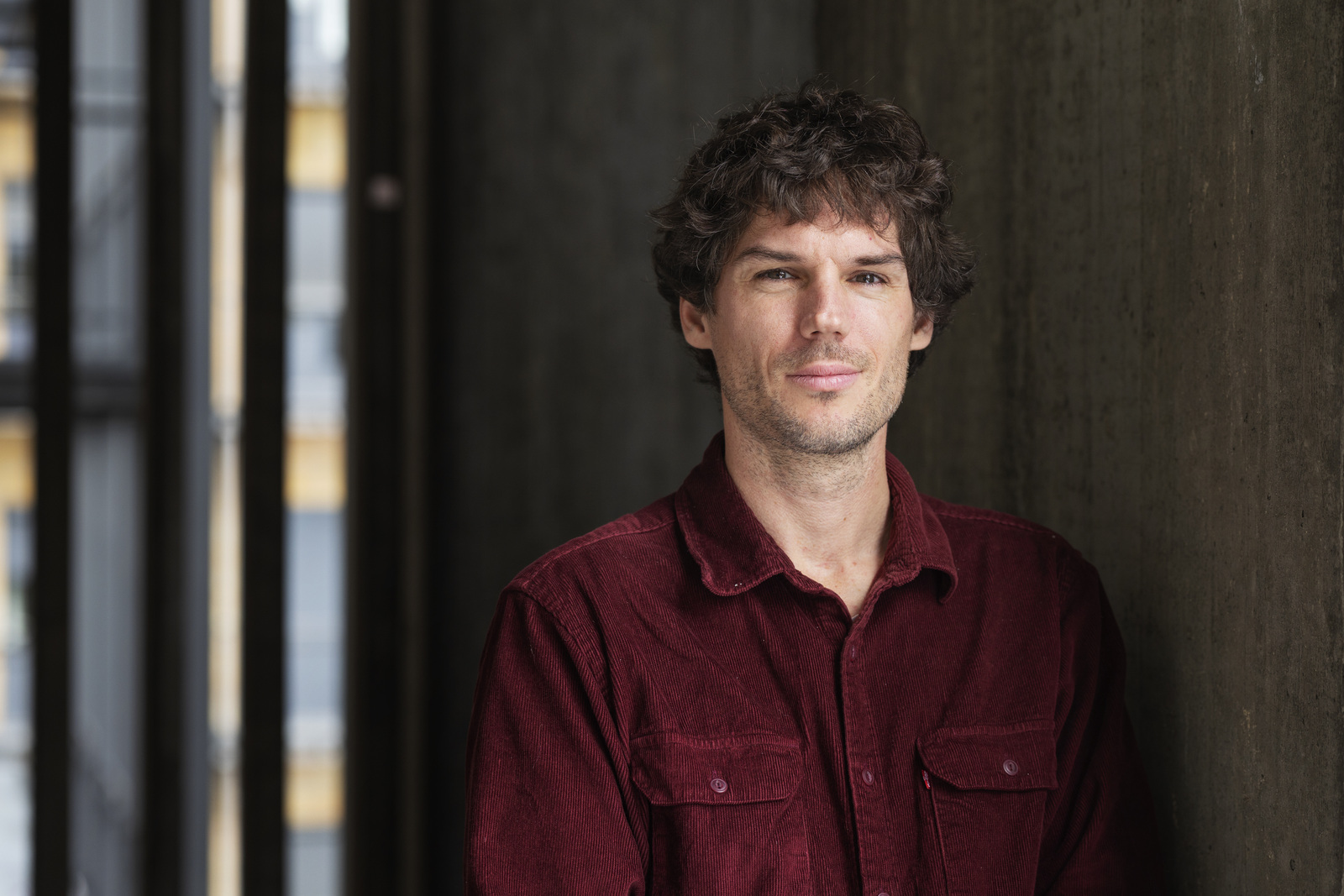
Silas Boye Nissen remembers the sense of wonder when he witnessed it through the microscope: Clusters of protein headed in the same direction.
“It looks as if the protein clusters are oriented by a magnet,” the Assistant Professor at University of Copenhagen says about the observation a few years ago.
It is a crucial aspect to the later-stage healing of wounds. His LEO Foundation Dr Abildgaard Fellowship project focuses on the cases where healing falters. In particular, older adults experience slow-healing wounds that can take several months to go away. Understanding the underlying molecular mechanism that slows down wound healing as we age may be relevant to several other skin diseases, such as eczema and psoriasis.
During the study he and his team want to figure out how protein clusters are properly oriented in fruit flies and in human skin models.
“Naturally there is a big jump from fruit flies to humans, but the proteins involved in human wound healing are preserved across species. Evolution has prioritized conserving these proteins.”
It took him five years of research to discover how a clustering process of so-called PCP proteins works in fruit flies.
“With this project I am asking: How do cells orient themselves to heal wounds in human skin? Can we help them obtain the right direction?”
Days when nature surprises you
To make the project he will collaborate with different sections within the Department of Biology at University of Copenhagen. Together they cover the flies, skin systems, and protein design. The interdisciplinary collaborations pose their own challenges, as the project’s scope connects physics, fundamental biology, and the health sciences.
“One of the perspectives I am navigating, while I am bridging different research areas, is that we can have different success criteria. With this project, we seek both a new understanding at the molecular level and to generate a long-term impact for patients.”
Patient impact is an integrated part of the project, as the knowledge about how proteins cluster might form the basis for a formulation to be applied to slow-healing wounds.
One of the things that got him interested in skin was its accessibility.
“The cellular structures we observe on our skin are also found inside our body, but inside our body, we cannot immediately access and see them.”
He notes that despite being within reach, there are still lots of things we do not understand about human skin.
“There has been remarkably little research on the proteins I study. What remains unknown is mind-blowing to me. It is deeply fascinating to examine something as one of the first researchers in the world.”
The unknown comes with a lack of complete control, he acknowledges.
“One day nature surprises you. For instance, when you see protein clusters within cells pointing in the same direction on a living fruit fly’s wing. For those moments, I am happy to accept that nature is unpredictable.”
Read more about the four 2026 LEO Foundation Dr Abildgaard Fellows here.