
Fungal Ecology Lab – Rasmus Kjøller Group
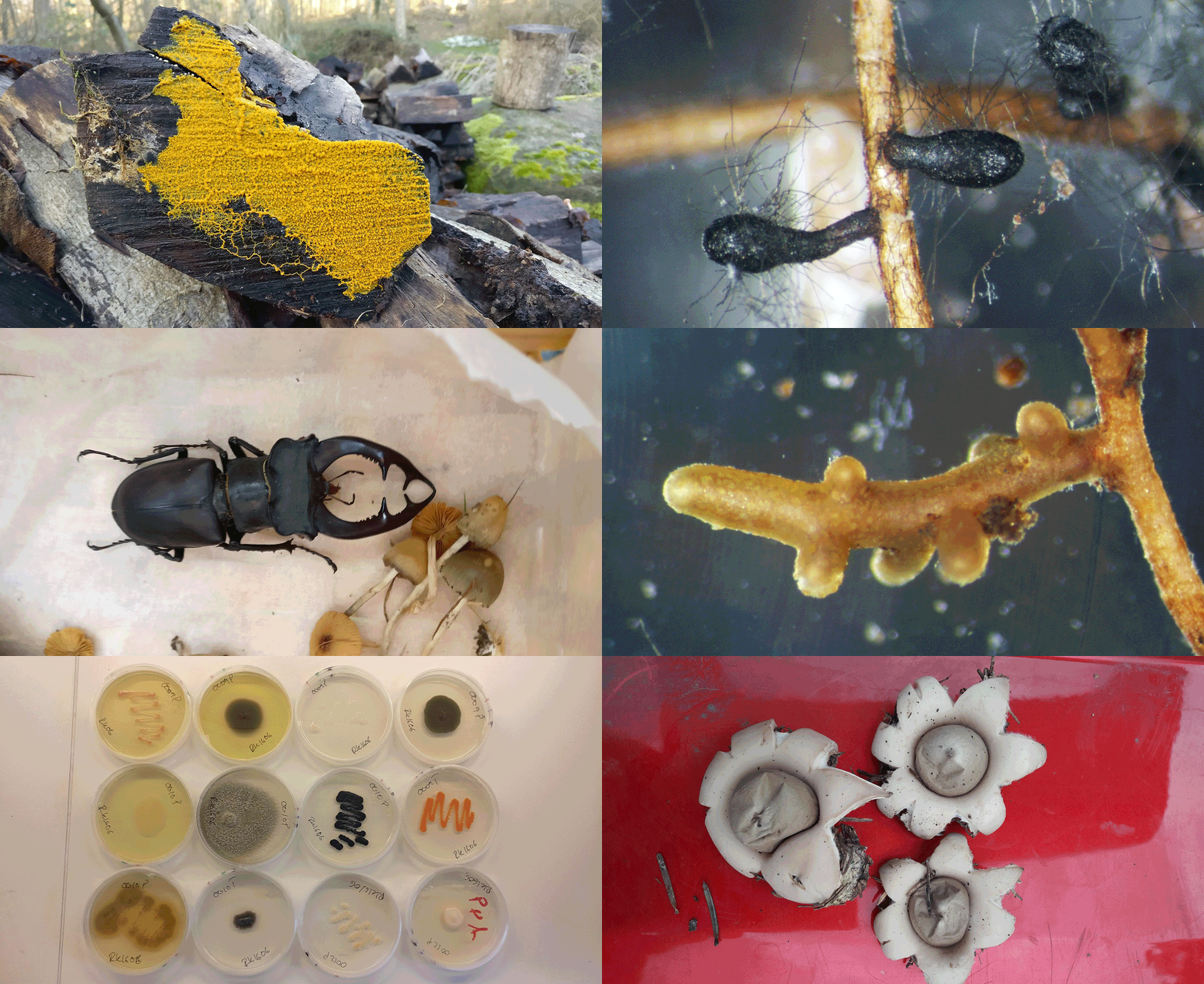
We apply molecular markers to disentangle the otherwise invisible fungal populations and communities associated with plants and soil. We map fungal communities in time and space, how environment filters affect fungal communities and how changes in fungal community composition feedback on ecosystem functions.
As model organisms, we work with symbiotic root colonizing mycorrhizal fungi as well as phyllosphere associated fungal communities including plant pathogens.
Besides the use of molecular markers, we are competent at applying biochemical markers as well as classical microscopic examinations to fungi.
Another methodological strongpoint are various mesh-enclosure techniques to study both the function and community of in particular mycorrhizal fungal mycelia in soil.
FUNCTIONAL INTERACTIONS BETWEEN TREES AND ECTOMYCORRHIZAL FUNGAL TRAITS
Most fungi are plant dependent – either as saprotrophs or as biotrophs that obtain their carbon (C) directly from interactions with living plants. The most abundant group of fungal biotrophs in forests are ectomycorrhizal fungi and, even though they obtain C – and thereby energy – from living plant cells, they also explore the soil for other nutrients, particularly nitrogen which they trade for C with their host trees. We, therefore, predict that litter quality has a significant impact on mycorrhizal fungal communities, and that their (response) traits should reflect the challenges associated with the litter input as a C source. We investigate this by measuring mycorrhizal fungal traits (morphological, enzymatic and genomic) across plots with four different tree species varying in litter quality, replicated in a unique common garden experiment found at six sites across Denmark. In future projects we are interested in how the fungal response traits e.g. mycelial structures feedback on ecosystems functions e.g. as C sequestration.
AFFORESTRATION AIDED BY MYCORRHIZAL INOCULTION
The Danish Tri-partite Agreement calls for large scale afforestation on former agricultural soil. As the agricultural soil lacks the microbiome of mature forests we will investigate if inoculation with mycorrhizal fungi can aid in the success of new forests, improve C-storage and speed up the succession towards old-stages biodiverse forests. We will investigate this with various inoculation sources ranging from single species over mixed species to complex whole soil inoculum. In related projects we investigate the natural fungal spore rain as a function of tree species, forests/open land matrix and geography.
AGGREGATE AND GENEPEASE II
Soil provides multiple ecosystem services to humans of course as being the fundamental basis for agricultural food production but also by storing carbon and providing clean drinking water. Soil aggregation correlates with SOM content, aeration and soil biodiversity. A healthy and fertile soil is well aggregated. Soil aggregation is a process where soil minerals and organic matter is enmeshed into a biological web including fungal hyphae and a matrix exuded by microbes. In Aggregate we wish to determine which soil biota are most important for the soil aggregation process across a range of different Danish soils with focus on fungal activity and hyphae. We also want to pinpoint potential troubles for the aggregation process - in specific of pesticides. The harmful side-effects of pesticides on soil health are further explored in the project GENEPEASE II. The two together will provide recommendations towards managing our agricultural soil resources in a sustainable way.
MATRIX
Ensuring sustainable food production for a still growing world population while at the same time minimize the use of pesticides in agricultural production systems is an intriguing challenge. In the Matrix project (Microbiome Assisted Triticum Resilience in X-dimension) we explore the potential of the indigenous wheat microbiome which focus on the phyllosphere to provide health and sustainable growth of wheat. We test the microbial interactions among the microbiome constituents, the microbiome-plant interactions as well as the potential of the microbiome to combat common fungal diseases and mitigate drought stress. We also map the genomic and metabolic diversity among our isolated strains and all data are modelled in deep learning neural networks. The end goal is to provide either management regimes or apply specifically designed and safe SynComs for improved plant health. The project is a large collaborative project with multiple partners from UCPH, DTU, NIOO (Netherlands) and North Caroline State University.
OTHER PROJECTS
Long-term focus within our research portfolio is community-, molecular- and functional ecology of mycorrhizal fungi with particular focus on the structure and function external soil mycelia of mycorrhizal fungi. For more specific projects, see Student Opportunities below.
To view publications, please visit Rasmus Kjøller’s profile on the KU Research Portal.
Current funding includes projects: MycoForest - Stimulating forest carbon uptake and storage by mycorrhizal inoculation (Innovation Fund Denmark, to 2029), Microbiome Assisted Triticum Resilience In X-dimensions – MATRIX (NNF, to 2027), Biological aggregate formation towards a healthy soil – AGGREGATE (NNF to 2026), Pesticide Effects on Agricultural Soil Ecosystems – GENPEASEII (MST, to 2026) and Above and belowground interactions in forests (DFF, to 2026).
Contact Rasmus if you are interested in BSc or MSc projects on any aspect of fungal ecology. If you have a general idea about what you would like to work with, we can develop this into an exciting project together.
Current student’s projects includes:
- Arbuscular mycorrhizal fungal mycelia in soil – importance for common mycelial networks and soil aggregation
- How do tree species control mycorrhizal fungi through leaf litter quality?
- Fungal foliar endophytes – composition and potential for plant protection
- Identification of Bd (chytridiomycosis) and amphibians from eDNA
- Development and test of a Soil Health Index Score to assess new agricultural management regimes e.g. rotational grazing and regenerative agriculture
We also have a list of specific project suggestions. Check these out on https://karriere.ku.dk/projects/denmark - search for Rasmus Kjøller
Group members
| Name | Title | Phone | |
|---|---|---|---|
| David Alejandro Castro Moraga | Postdoc | +4535327064 | |
| Jesper Liengaard Johansen | Assistant Professor | +4535332317 | |
| Rasmus Kjøller | Associate Professor | +4535322311 | |
| Yasmine Cirstea | Research Assistant | +4535322668 |
Alumni
| Alumni | Title | Link |
| Alma Njeri Agha | MSc | |
| Amélie Buisine Middelfart | Researcher | |
| Andrea Therese Kaaber | MSc | |
| Carla Cruz Paredes | PhD | |
| Christoffer Bugge Harder | MSc | |
| Elise Ida Blum Samuelsen | MSc | |
| Hongyi Wang | MSc | |
| Jens Rasmus Plantener Jespersen | MSc | |
| Jon Mølgaard Michelsen | MSc | |
| Jonas Thomsen | MSc | |
| Karina Cavour Jagd Frederiksen | MSc | |
| Kirsten Føns | MSc | |
| Klara Rask | MSc | |
| Leva Marija Sokolovaite | MSc | |
| Marie Højmark Fischer | PhD | |
| Marie Merrild | PhD | |
| Marta Gil Martínes | Postdoc | |
| Nanna Slaikkjer Pedersen | MSc | |
| Qian Lyu | PhD | |
| Robin Mikaela Kotsia | MSc | |
| Sanjana Sudheer Bhat | MSc | |
| Thomas Rumle Thaaning Jensen | MSc | |
| Tobias Gulberg Frøslev | PhD | |
| Tobias Normann Levin Larsen | MSc | |
| Toke Bang-Andreasen | PhD | |
| Tue Rønhave | MSc |