
The interconnection between biofilm formation and horizontal gene transfer
Project type: Bachelor, Master
Keywords: Biofilm formation, horizontal gene transfer, social evolution, sociomicrobiology, plasmids, molecular microbiology
Over the last few years we have been studying natural plasmids that encode genes that enables biofilm formation. This research has indicated that biofilm formation and plasmid biology are interconnected and act as a positive loop that promotes both through various mechanisms. Grasping this connection helps us to understand how social bacterial traits can evolve and this is very important when looking at how, why, where and when bacteria evolve into e.g. pathogens or commensals of humans.
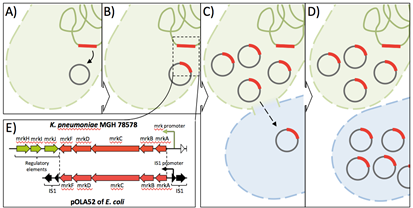
We have, until now, been looking specifically at plasmids that prime biofilm formation via type 3 fimbriae (typically incX1 plasmids), K88 fimbriae and type 4b shufflon pili (incI-cluster). We will be able to use these plasmids as the starting point of further research projects, which will be convenient as we already have the full nucleotide sequences, cloned alternative and knockout mutants available.
This project has multiple aspects and can be directed according to your interests, whether they lean towards medical microbiology, ecology, or sociomicrobiology. The main techniques you will be using are based in molecular biology
References:
Burmølle et al., 2008 Microbiology, Rankin et al., 2010 Heredity
Supervisors:
Jonas Stenløkke Madsen (jsmadsen@bio.ku.dk)
Mette Burmølle (burmolle@bio.ku.dk)
Søren J Sørensen (sjs@bio.ku.dk)
Section of Microbiology

Contact
Section of Microbiology
Universitetsparken 15, build. 1, 1. floor
DK-2100 Copenhagen
SUPERVISORS
Professor Mette Burmølle
E-mail: burmolle@bio.ku.dk
Tenure track assistant prof. Jonas Stenløkke Madsen
E-mail: jsmadsen@bio.ku.dk
Professor Søren Sørensen
E-mail: sjs@bio.ku.dk