

Sign up to receive news and updates on EMBARQ.
EMBARQ: Evaluating Microbiome Based Applications for Risk Quantification
From Natural Variation to Real Risk: Modernizing the Safety Assessment of Microbial Bioinoculants
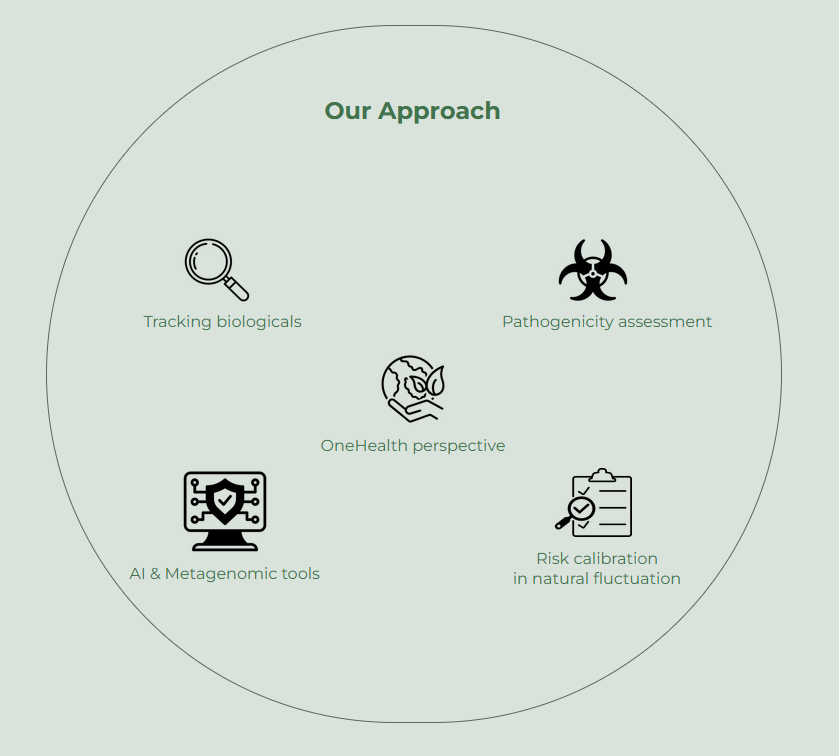
EMBARQ's primary purpose is to provide a knowledge base and develop innovative tools for quantifying the impact of novel biological agents, facilitating rapid assessment methods for industry and regulators.
EMBARQ addresses the need for improved risk assessment of living microbial bioinoculants used in agriculture and environmental management. We aim to fill fundamental knowledge gaps in microbe-environment and microbe-microbiome interactions to predict the impacts of bioinoculant use on human and environmental health and ecosystem services.
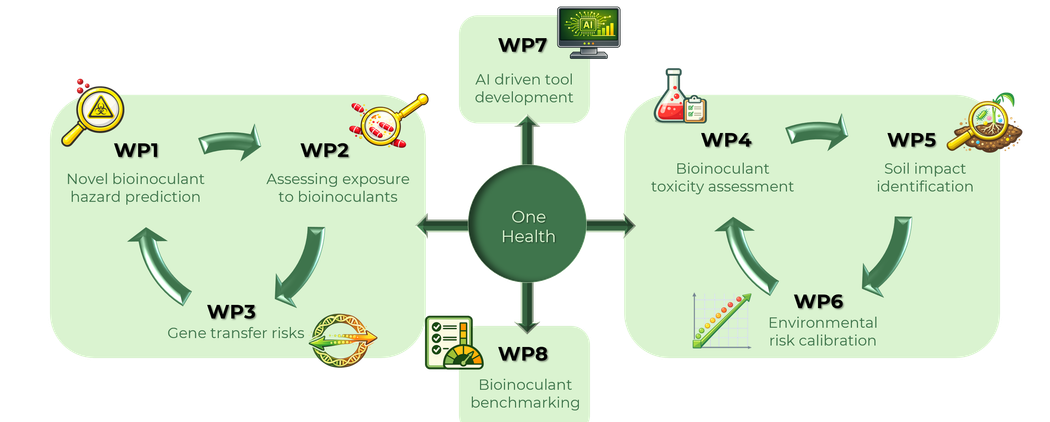
EMBARQ will expand traditional risk assessment steps to cover various risk factors, e.g how horizontal gene transfer may affect pathogenicity, and assess environmental impacts
The research project aims to quantify the impact of biological use, track biologicals in the environment using AI, and build a risk assessment framework to enhance safety, sustainability, biodiversity, and ecosystem services.
-
Hazard assessment
EMBARQ gathers relevant data on factors such as horizontal gene transfer or key microbes. -
Microcosm experiments
EMBARQ uses methods such as metagenomics to investigate effects of perturbation and large-scale variation. -
In silico validation
EMBARQ investigates geographic and climatic variation using Al, bioinformatics and big data. -
Field trials
EMBARQ investigates bioprotection and bioremediation using metagenomics, transcriptomics and metabolomics. -
Chemical analysis
EMBARQ employs advanced techniques to provide chemical analyses of metabolites, toxins and bioinoculant by-products. -
Impact
EMBARQ will develop recommendations based on research findings to support safer and more sustainable practices.

NEWSLETTER
Supported by

EMBARQ is funded by the Novo Nordisk Foundation for the period 2024–2030 and brings together partners from the University of Copenhagen, Aarhus University, Aalborg University, and the Statens Serum Institut.